
This year we celebrate 30 years of the Arab Film Festival, and the celebration wouldn’t be complete without shining a spotlight on one of the most dedicated contributors to AFMI, Sharif Ezzat.
Sharif Ezzat is the artist behind our organization’s logo, and has consistently designed our yearly Arab Film Festival poster for the past 23 years. His art is such an important part of the festival and captures the energy of each edition, so we invited him to share what it’s been like for him all these years, his process, and the inspiration that guides him in his work and love for Arab cinema.
Here’s what he told us.
Psst: The 30th Arab Film Festival opens on November 5th is San Francisco. Check it out!
AFMI: How did you get into design?
Sharif Ezzat: I’m the third child of an engineer and an artist; my sister and brother provided my parents with the obligatory doctor and engineer, so I was mostly free to chart my own course. After following many creative paths, I found that design combined artistic and engineering skills in a really compelling way. I studied typography, illustration, and screen printing in high school, while being drawn intellectually to literature, philosophy, and symbolic logic. At the time, the internet was just emerging, so I began teaching myself technical skills like HTML and Javascript. Eventually these synthesized into interactive digital art, and I traveled the world working with groups of artists who were exploring this new field. After college this became a digital design career, and I’m still learning and exploring new technologies and techniques.
AFMI: You have created the poster for the Arab Film Festival for the past 23 years. How did it all start?

Sharif Ezzat: I was originally recruited by a filmmaker friend to design and build a website for the festival, and not long after I had the opportunity to design the key art. One of the first posters I made allowed me to express a lot of different ideas about identity, diaspora, and representation, and received such a great response that it became an annual project.
AFMI: Often the poster design begins before we even know which movies will screen at the festival. How do you find inspiration? And what is your process when designing each poster?
Sharif Ezzat: There are some themes that are ever-present when thinking about the role of film in society: the idea that films allow us to mentally travel to another place, inhabit another perspective of the world, and experience lives that differ so much from our own, yet feel immediate and intimate. Films as portals, vision and illumination, seeing and being seen… much of my artwork for the festival plays on these ideas, filtered through my experience as an Arab American and the heritage of Arabic and Islamic art.
The process is the same yet different each year: I meet with the AFF team to understand what sort of films they’re seeing from Arab filmmakers and try to synthesize that with the cultural moment. Typically I produce 2-3 concepts, then we review with the broader team and choose one direction or elements from both to develop further. Sometimes things happen and we need to change direction later. I’ve learned from decades of design practice not to become overly attached to any particular concept, but to stay nimble.
AFMI: Do you have any favorite posters? Will you tell us about some of your favorite designs? [You can click on each poster to see it bigger]
Sharif Ezzat: The 2005 poster was certainly my most personal. The composition is built from layers of representation: the colorful film images grab your attention, which is then drawn to a sepia-toned layer of family photos from Cairo in the 1950s and 60s (including my mom and dad as teenagers). Beneath that is a world map using an orientation which shows the Earth as one continent and lines representing migration, displacement, or connection.
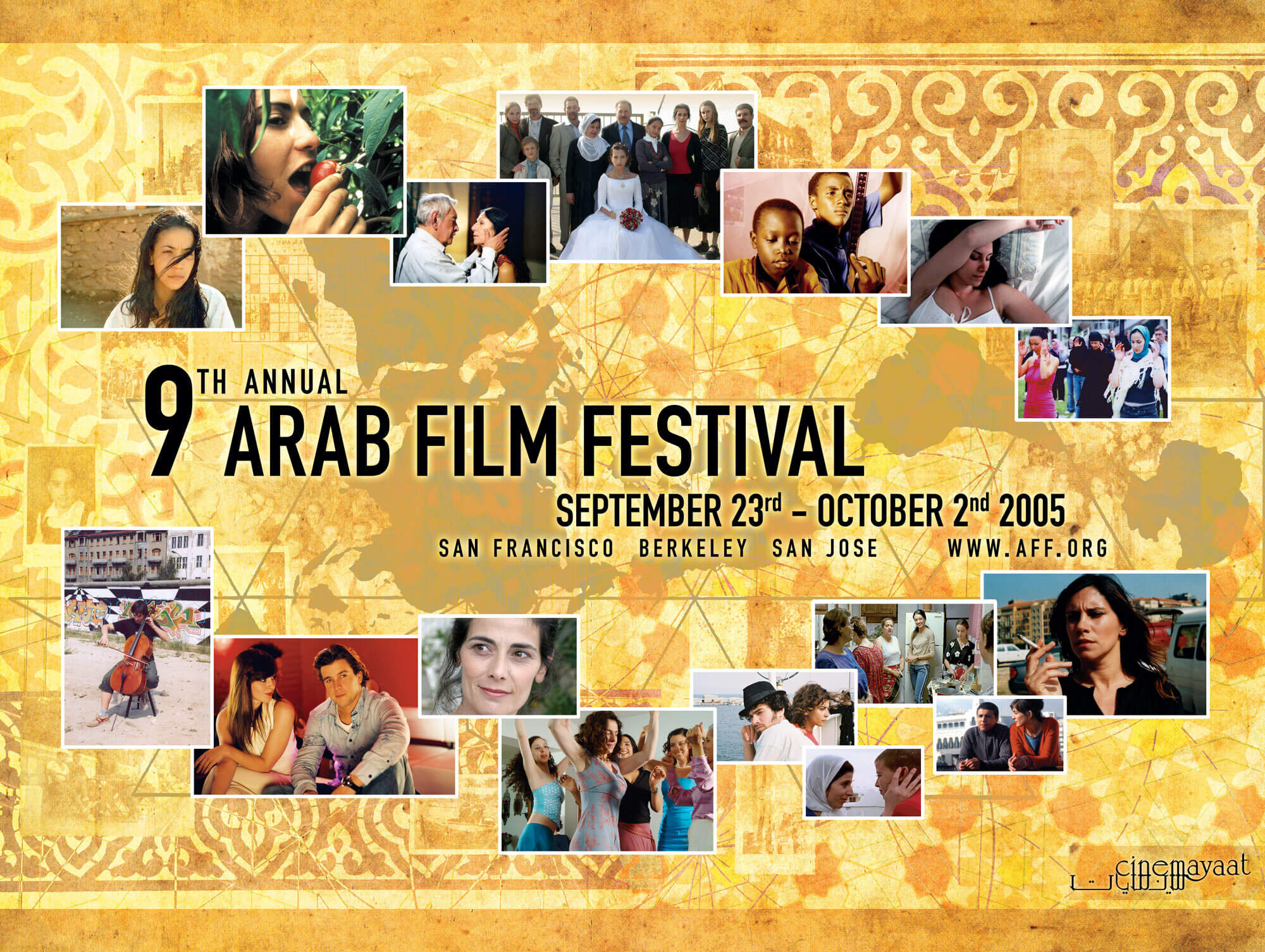
The 2005 Arab Film Festival Poster – by Sharif Ezzat
For the 22nd AFF poster, I was inspired by the surrealist artist Magritte to create a striking composition that explores ideas of identity and representation. The radial pattern focuses attention on the female figure, but inside the hijab we see only a blue sky. Can we ever really know another person or understand their world? For Arab women in particular, there is so much social pressure to perform a traditional role or fulfill expectations. Films offer a glimpse into the lives of others, a chance to see them as they see themselves.
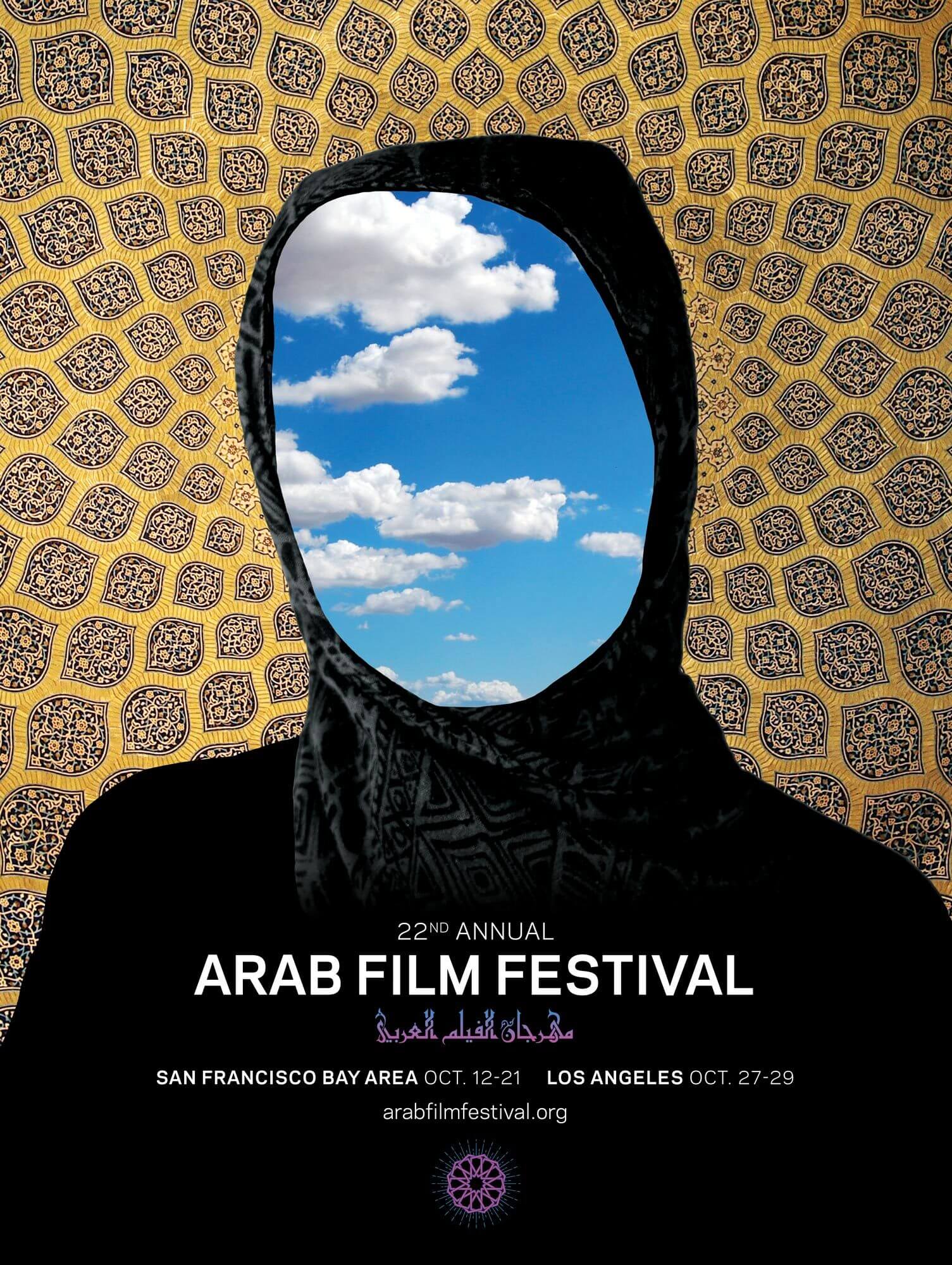
The 2018 Arab Film Festival Poster – by Sharif Ezzat
In this artwork [AFF2019 Poster], I wanted to explore the relationship between the objective lens of the camera and the layered, subjective reality of the world it attempts to capture. Inspired by the North African films featured in the 2019 festival program, I used traditional tile patterns from the region as the core geometric element to build the visual foundation.
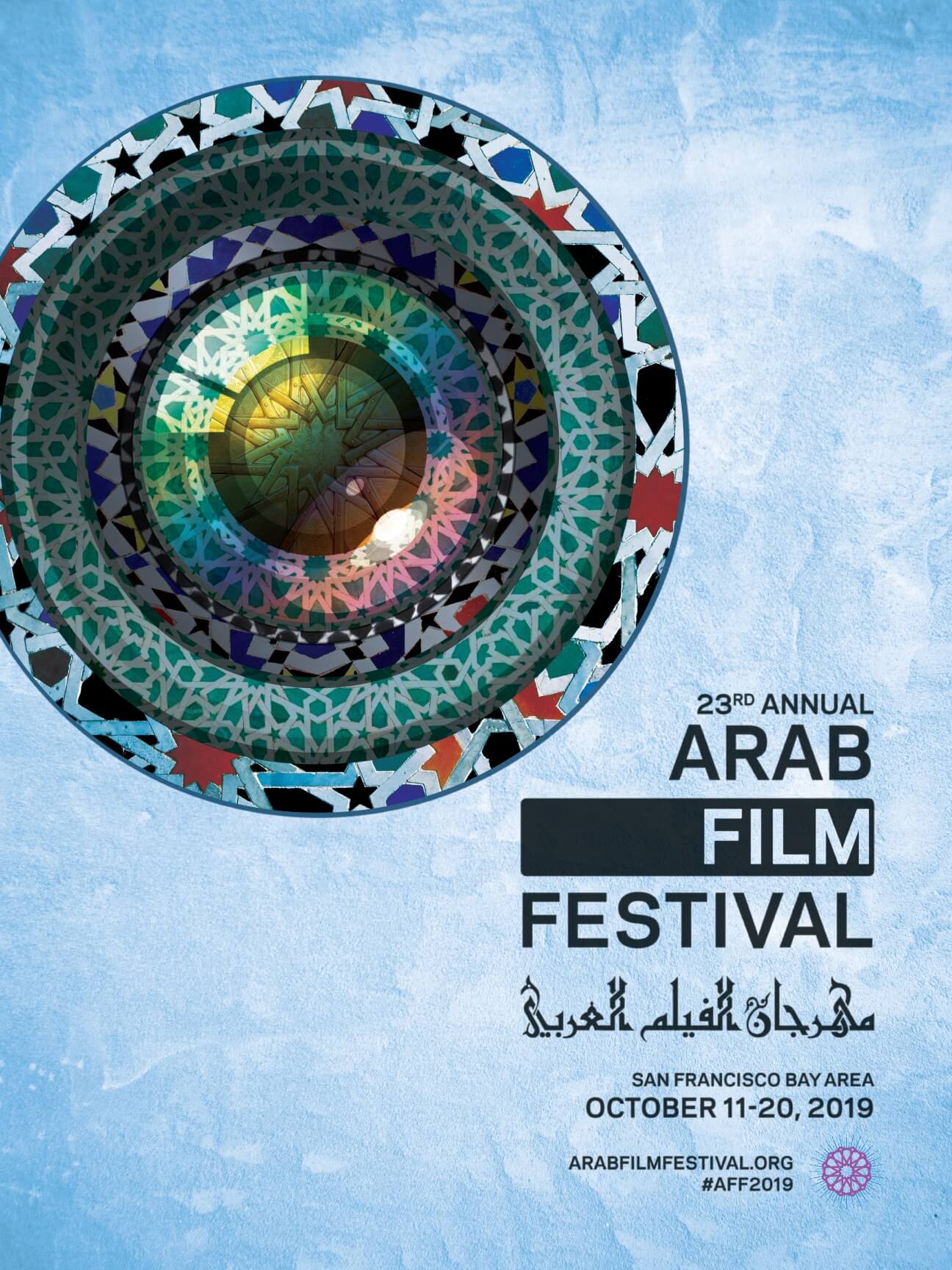
The 2019 Arab Film Festival Poster – by Sharif Ezzat
The hamsa is a symbol of protection, power, and strength. In the poster for the 2022 Arab Film Festival, the hamsas form a circle, illuminating each other. They are oriented so that they face their diametric opposites (represented as inverted color gradients) suggesting that by truly seeing each other we can protect and strengthen all.
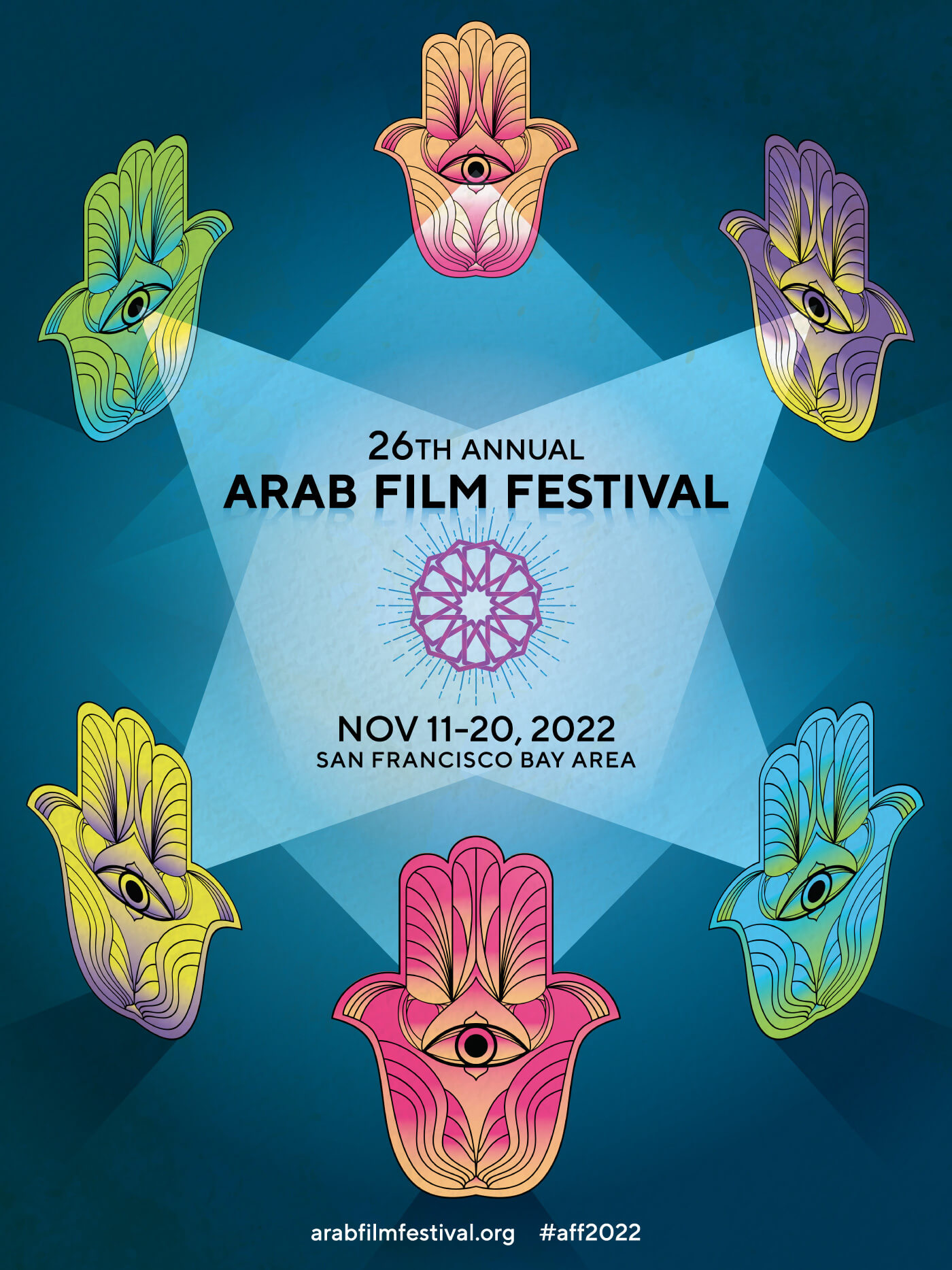
The 2022 Arab Film Festival Poster – by Sharif Ezzat
In 2024 we had the opportunity to host the Arab Film Festival’s Opening Night at the Palace of Fine Arts, a beautiful Beaux-Arts landmark in San Francisco. I spent hours sketching the architecture, and developed this composition which imagines the arches as portals to different Arab cities, offering the viewer direct access to the narrow alleys of Cairo or Damascus.
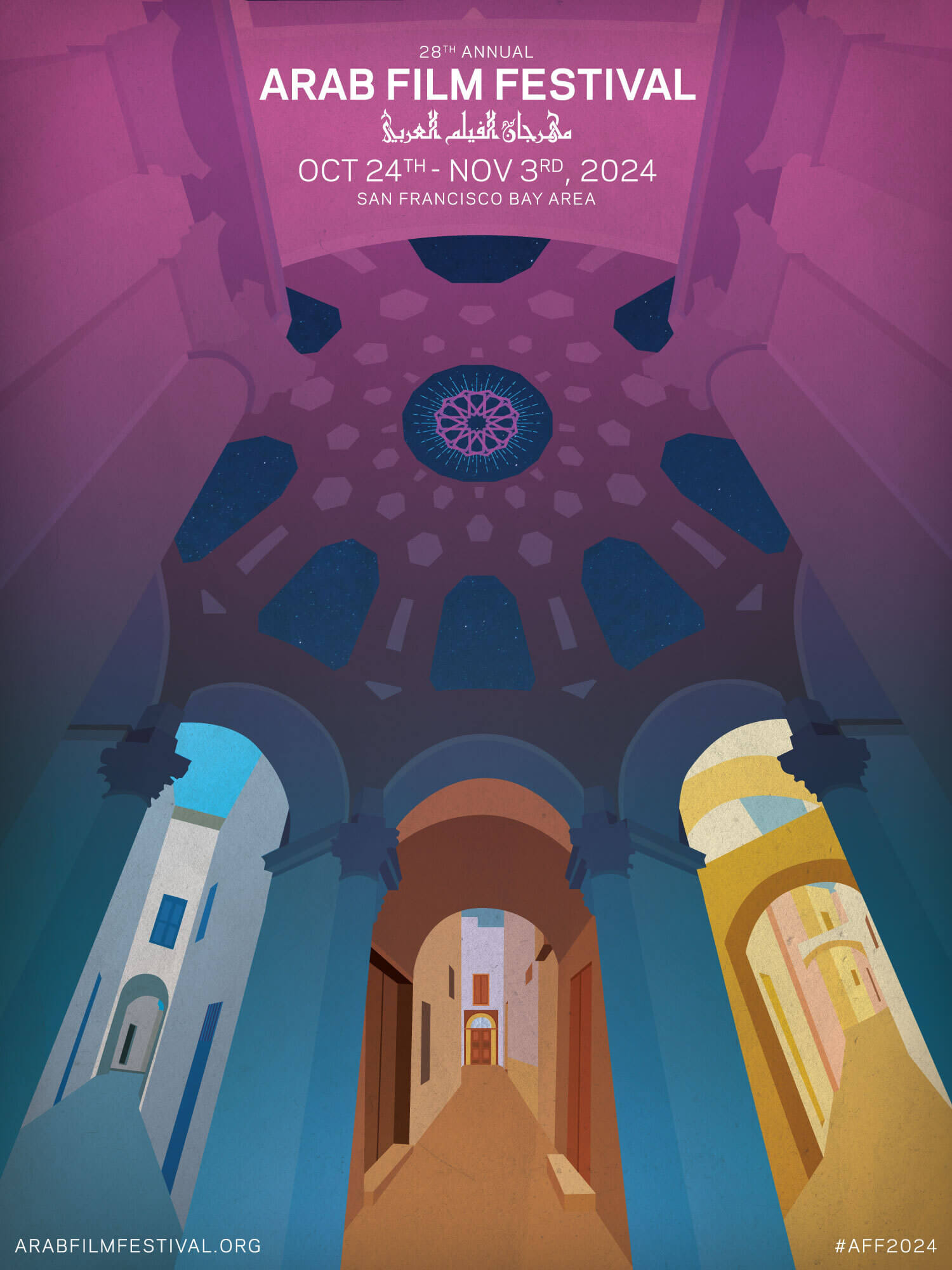
The 2024 Arab Film Festival Poster – by Sharif Ezzat
AFMI: AFMI has an iconic brand, and it all started in 2016 when you created our new logos. Will you share how you went about redesigning the brand?
Sharif Ezzat: For AFMI, I wanted to create an identity that was bold and modern, yet rooted in the visual language of our culture. I chose the interlaced twelve-pointed star as the core geometric design element as it suggests interdependence and balance, and added the light rays emerging from it to suggest illumination or brilliance. The star uses perfect lines while the light rays are imperfectly hand-drawn, which represents the relationship between ideal and manifest realities: great films capture that relationship when they express universal truths revealed through our messy human lives, which is what I hope we are bringing to people through the festival. AFMI consists of four pillars, so I created a design system in which each pillar uses the same symbol but is color-coded, and the main logo combines all these colors in a seamless gradient.
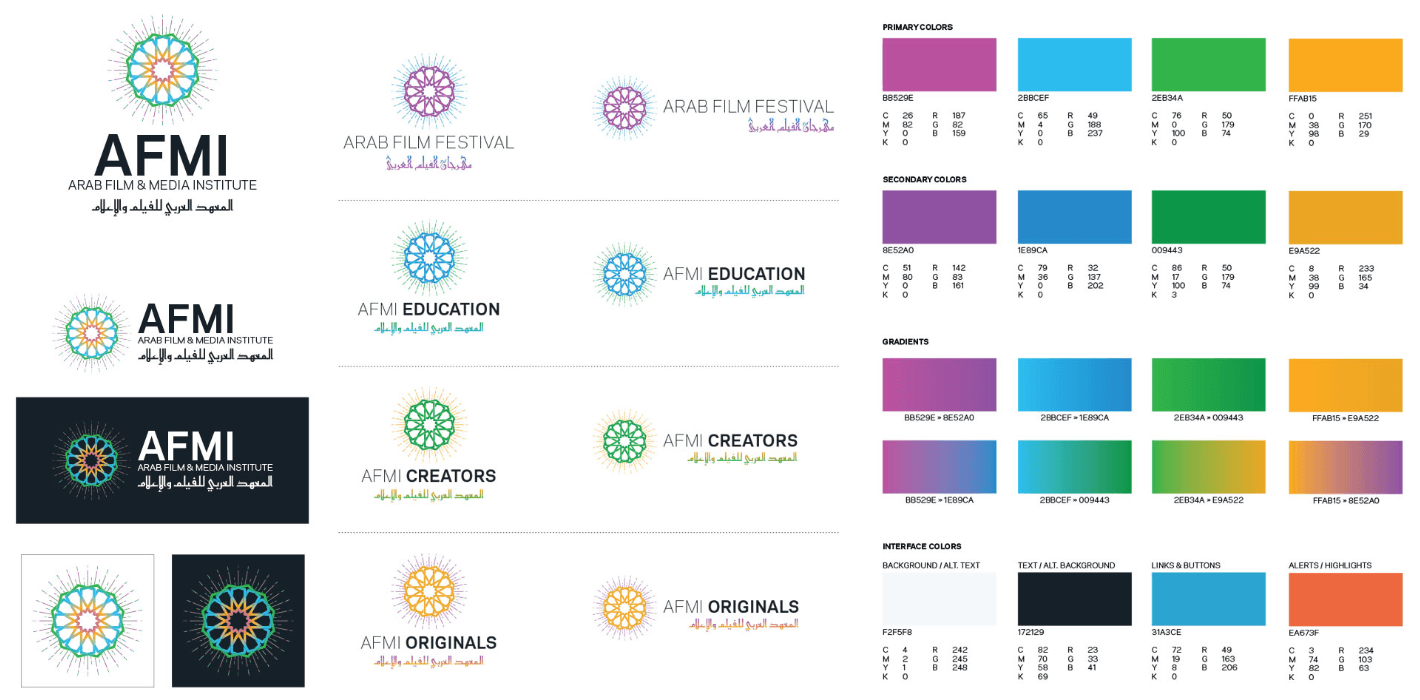
Editor’s Note: AFMI Originals became AFMI Industry
AFMI: Every year you also join us at the festival as a film fan. As a festival attendee, what do you love the most about AFF?
Sharif Ezzat: I love seeing films that aren’t widely available (yet!) which reflect authentic Arab experiences. I find that American films are usually neatly divided into genres, while Arab films (and many other international films) are harder to pin down; like real life, they’re often a blend of drama and comedy, conflict and misunderstanding. I also really enjoy seeing the audiences turn out to support these filmmakers. There’s nothing like watching a new film with a group of strangers, laughing in the dark together in a moment of shared understanding.
AFMI: When you are not busy with AFF, what kind of work do you do?
Sharif Ezzat: Most of my work is actually in science communication. I work with biotech companies and academic researchers to convey exciting advances in science and medicine through design: illustration, animation, video, games, and custom software. I love to nerd out on the amazing science happening in the Bay Area, and feel a duty to use my skills to help the people making a better future possible for all of us.
AFMI: Anything else you’d like to share?
Sharif Ezzat: It took me a long time to understand what it means to me to be an Arab American. When I visit my family in Egypt and when I talk with my American friends, I feel the same tension between generations, between classes, between hope and cynicism. I hope that young Arabs struggling to find their place in a changing America might encounter a film through this festival that speaks to their struggle and reminds them of its universality, and that non-Arab Americans see through these films that our lives are inexorably tied to each other. Being Arab American to me means having the privilege of an outside perspective on both cultures, and using it to bear witness to aspects of each that are difficult to perceive from within.
Would you like to learn more about Sharif’s work? Visit his website at sharifezzat.com
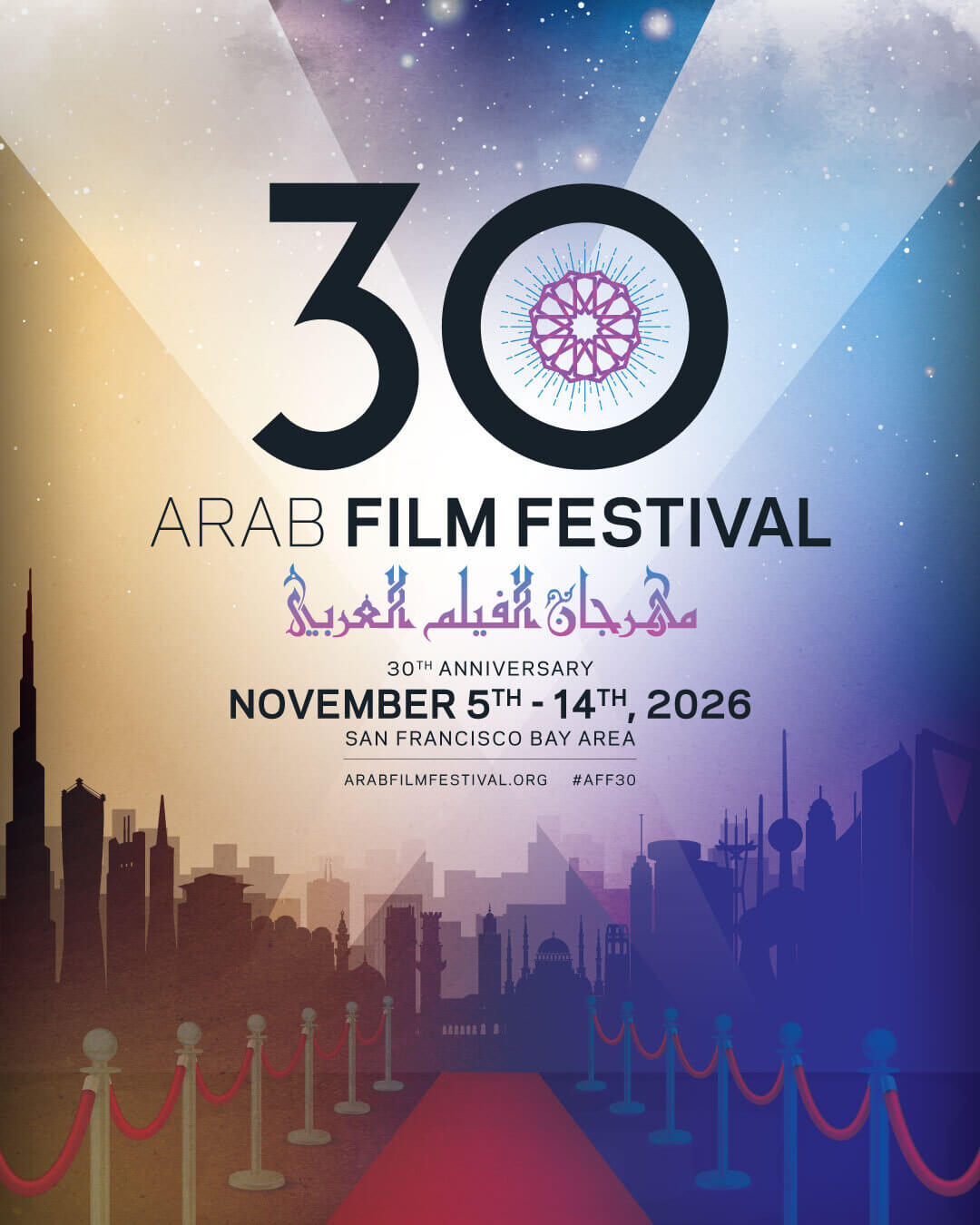
AFF30 Poster by Sharif Ezzat
And if you are in the San Francisco Bay Area, don’t miss the 30th Arab Film Festival. The festival opens on Nov. 5th and will run through Nov. 14th. Here’s the poster, designed of course by Sharif Ezzat.




Leave A Comment